What changes for US economic policy?
What happened?
On 3 November, Democrats won control of the House and the Senate. They flipped seven Senate seats, in some states for the first time in decades.
Last Democratic Senate win before this election
- Texas: 1988. Now won by James Talarico.
- Kansas: 1932. Now won by Adam Hamilton.
US Senate races 2026, as of 5 November
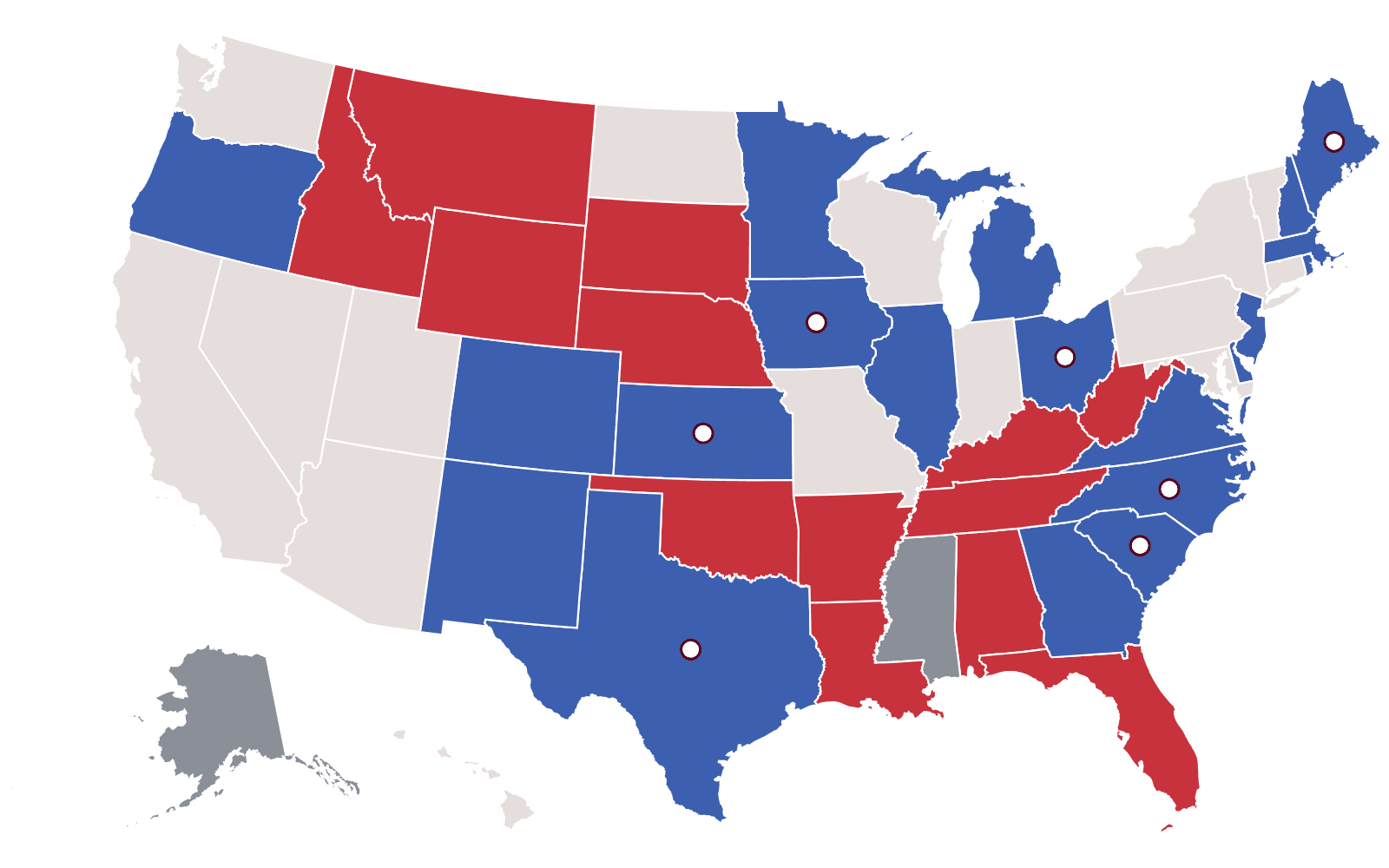
Map legend: blue = Democrat won; red = Republican won; grey = still open; light grey = no Senate race; outlined circles = flipped to Democrats.
Sources: The Associated Press (AP) via Oneindia (race results), CBS News (projections, flips), Fortune (Texas), KCUR (Kansas), 4–5 Nov 2026. Map: own illustration
What caused the swing?
The economy was the top issue for about 4 in 10 voters.
Trump’s approval
| Response | Share of voters |
|---|---|
| Approve | 38% |
| Disapprove | 62% |
Trump's approval is lower than at any midterm since 2006.
- US inflation was 3.7% in September, and gas hit a record $4.15 a gallon.
- About two-thirds of voters said Trump's tariffs hurt the economy.
- About half of voters said government corruption was crucial to their vote.
- In a Fox News poll in September, more than 60% of voters called the Iran war the wrong decision.
Sources: AP Voter Poll via PBS (top issue, tariffs, corruption), Fortune (NBC exit poll), CBS exit polls via Yahoo, CBS News (gas via AAA), all 4 Nov 2026, Fox News poll via Al Jazeera (Iran, 18 Sep), Reuters (inflation)
How did markets react?
The result was largely priced in. On Election Day, prediction markets gave Democrats a 77% chance in the Senate and 94% in the House.
Closing moves on 4 November
| Market | Closing change |
|---|---|
| Dow Jones | +3.0% |
| STOXX Europe 600 | +1.8% |
| S&P 500 | +1.6% |
| Nasdaq | +1.4% |
| US Oil (WTI) | −8.3% |
Still, the Dow had its best day since April 2025. CNBC links the rally to the clear-cut win and falling oil. The 10-year yield fell to about 4.85%, and the chance of a Fed hike in December dropped from 84% to 77%.
Sources: Forbes (prediction markets, 3 Nov), CNBC and CNBC via StockTitan (rally, US indices), MarketScreener (WTI settle), Reuters (STOXX 600), all 4 Nov 2026, Trading Economics (yield, Fed odds, 5 Nov 2026)
What does this mean?
Power in Washington is split. Democrats now control Congress, but Trump stays in the White House until January 2029.
For the White House
Trump keeps his veto. To overrule it, Congress needs two-thirds of both chambers, and neither party has that. But the Senate can now block his Cabinet members and judges.
For fiscal policy
Trump had promised every adult a $5,000 payment if Republicans kept Congress. The plan would have cost over $1tn and is now off the table. J.P. Morgan AM expects smaller deficits.
For trade
Tariffs will likely stay. “Trade is another power the president can wield unilaterally”, says ING. So new tariffs on Europe are still possible.
Sources: Reuters via Yahoo Finance (veto, two-thirds, 1 Nov; J.P. Morgan AM, 4 Nov), TIME (Senate, 4 Nov), WLRN ($5,000 plan, 10 Sep), Euronews incl. ING (trade, 4 Nov 2026)